Baked Chicken Katsu Parma


Date Published: August 15th, 2020 | Last Updated: August 15th, 2020
Author: Abby |Category: mains
Serves: 4 | Prep time: 15 mins | Cook time: 30 mins

Jump to recipe |

This past week we’ve been using more eggplant in our cooking, a vegetable that we previously never really touched. We’ve actually made some pretty tasty dishes with eggplant including sweet chilli eggplant and a few more dishes that I’ll be posting soon. I found a popular recipe for an eggplant parmesan from Jamie Oliver and decided to give it a go. Toby LOVES a good parma, so you can imagine his disappointment when he thought an eggplant parmesan was a chicken parma with eggplant on top, rather than an eggplant-style lasagne. In the end our eggplant parmesan turned out well, but I felt bad that Toby never got the parma he was so excited for so we put parma on this week’s menu. We decided to use the baked chicken katsu recipe to make it a healthier (and crunchier) alternative and topped it off with our own marinara sauce. It was SOOOOO good. Toby said it was one of the best parmas he’s ever had, especially with the homemade marinara.

Anyways, without further ado, here’s the recipe! If you have any comments or suggestions, I’d love to hear from you in the comment section! You can follow me on instagram, youtube and facebook to see all the recipes I post!

Happy cooking!

Ingredients you’ll need:

  • 2 cups panko (Japanese breadcrumbs)
  • 2 Tbsp extra virgin olive oil
  • 1/2 cup parmesan cheese, grated
  • 2 Tbsps Italian seasoning (or dried oregano)
  • 4 chicken breasts, butterflied
  • salt & ground black pepper
  • 4 Tbsp all-purpose flour (plain flour)
  • 2 large eggs, beaten
  • 2 cups marinara sauce
  • A few slices of mozzarella cheese per parma
  • Basil leaves (for garnish)

Directions:

Cooled toasted panko with parmesan and Italian seasoning

On a pan on medium heat, toast the panko with the olive oil. Stir to combine and toast until golden brown. Then put your panko in a large bowl and set aside to cool. Once cooled mix in parmesan cheese and Italian seasoning.

Preheat oven to 200˚C.

Rinse your chicken and pat dry. Butterfly the chicken breasts and season with salt and pepper on both sides. Follow the photos above to butterfly the breasts or click here for a more descriptive tutorial.

In two large bowls or plates, place flour in one and beaten eggs in the other.

Now bread your chicken in this order:

  1. Dunk the chicken breast in the flour bowl to cover both sides. Shake off any excess flour.
  2. Next coat it in the beaten eggs.
  3. Finally coat it in the toasted panko parmesan mixture, pressing the crumbs in slightly to help them stick.

Place the katsu onto a wire rack over an oven tray. Bake for about 20-25 minutes on the middle rack until the chicken is no longer pink inside. If you have an oven thermometer, your chicken should be about 74˚C.

When the chicken is cooked, put a few spoonfuls of marinara sauce over each katsu then top with mozzarella cheese. Put it back on the oven and broil on HIGH until the cheese is bubbly and melted (~1 minute).

Top each parma with a few slices of fresh basil and serve immediately. Done!

Summarized Recipe:

Baked Chicken Katsu Parma

Date Published: August 15th, 2020 | Last Updated: August 15th, 2020
Author: Abby |Category: mains
Serves: 4 | Prep time: 15 mins | Cook time: 30 mins

Ingredients:

  • 2 cups panko (Japanese breadcrumbs)
  • 2 Tbsp extra virgin olive oil
  • 1/2 cup parmesan cheese, grated
  • 2 Tbsps Italian seasoning (or dried oregano)
  • 4 chicken breasts, butterflied
  • salt & ground black pepper
  • 4 Tbsp all-purpose flour (plain flour)
  • 2 large eggs, beaten
  • 2 cups marinara sauce
  • A few slices of mozzarella cheese per parma
  • Basil leaves (for garnish)

Directions:

  1. On a pan on medium heat, toast the panko with the olive oil. Stir to combine and toast until golden brown. Then put your panko in a large bowl and set aside to cool. Once cooled mix in parmesan cheese and Italian seasoning.
  2. Preheat oven to 200˚C.
  3. Rinse your chicken and pat dry. Butterfly the chicken breasts and season with salt and pepper on both sides (click here for tutorial).
  4. In two large bowls or plates, place flour in one and beaten eggs in the other.
  5. Now bread your chicken in this order:
    1. Dunk the chicken breast in the flour bowl to cover both sides. Shake off any excess flour.
    2. Next coat it in the beaten eggs.
    3. Finally coat it in the toasted panko parmesan mixture, pressing the crumbs in slightly to help them stick.
  6. Place the katsu onto a wire rack over an oven tray. Bake for about 20-25 minutes on the middle rack until the chicken is no longer pink inside. If you have an oven thermometer, your chicken should be about 74˚C.
  7. When the chicken is cooked, put a few spoonfuls of marinara sauce over each katsu then top with mozzarella cheese. Put it back on the oven and broil on HIGH until the cheese is bubbly and melted (~1 minute).
  8. Top each parma with a few slices of fresh basil and serve immediately. Done!

Khao Soi (Thai Coconut Curry Noodle Soup)


Date Published: August 11th, 2020 | Last Updated: August 11th, 2020
Author: Abby |Category: mains, soups, asian, quick and easy
Serves: 4-6 | Prep time: 5 mins | Cook time: 15 mins

Jump to recipe |

Khao Soi? Oh boy! If you’ve never had Khao Soi before, you’re about to have your taste buds obliterated because this dish is THE BOMB (I’ll see myself out). It uses an intense curry paste that’s similar to red curry but with the addition of curry powder (like a yellow curry paste) which is then simmered with coconut milk that results in a luxe creamy coconut curry soup with some heat. This northern Thailand dish is commonly served with egg noodles, chicken, and topped with crispy noodles. There are many variations of this dish and you can easily customize it yourself with extra veg, tofu puffs, fish cakes…etc.

I’m going to admit something here. I’m actually pretty new to Khao Soi and only heard about it a month ago on Masterchef (when Jess made it in the ramen challenge) and I haven’t been able to get it out of my mind since. I LOVE curries, especially Thai curries for their aromas so it’s no surprise that Khao Soi instantly made it straight to the top of my (long) list of dishes to make. Since I’ve never had Khao Soi from Thailand I can’t attest to how “authentic” my recipe is to the real thing but I can guarantee that this recipe is f*cking delicious. I ate two bowls in one sitting the first time I made it! Move over green curry, I actually think this may be my new favourite Thai curry. Since I’m a novice to Khao Soi, I came up with this recipe by reading through a LOT of highly rated “authentic” recipes and compiled all the best parts together. I’m surprised I pulled it off!

I’m a huge advocate of homemade curry paste because it just has so much vibrant flavours that you can’t get from a can without “freshening it up” with aromatics. I used my pre-made homemade Thai red curry paste for this recipe which saved SO much prep work and made this recipe infinitely easy and fast to come together (I haven’t tried this with canned paste so apologies to anyone that was hoping to use it. If you try it, let me know how it turns out!). This dish takes about 15-20 mins from start to finish. The only thing you need to chop is the chicken! So quick and easy for something SO full of flavour.

Hopefully one day when this pandemic is over I’ll be able to travel to northern Thailand and have Khao Soi to see how it compares. It’s a shame because I was actually in Chiang Mai last year for 3 weeks volunteering at an animal shelter desexing stray dogs and cats. The whole time I was there no one mentioned Khao Soi but I did have some pretty amazing green curry. Ah well, another excuse to travel! 😊

Anyways, without further ado, here’s the recipe! If you have any comments or suggestions, I’d love to hear from you in the comment section! You can follow me on instagram, youtube and facebook to see all the recipes I post!

Happy cooking!

Ingredients you’ll need:

  • 4 portions of egg noodles
  • Khao Soi paste:
  • 1kg chicken thighs (or breast), diced into large pieces (or to preference on how big you prefer your chicken pieces)
  • 4 cups (1 litre) reduced salt chicken stock (or vegetable stock)
  • 600ml (1 1/2 cans) coconut milk
  • 2 Tbsps fish sauce (or more to taste)
  • Optional: any additional veg you like

Directions:

Cook the egg noodles according to package instructions. Drain and rinse under cold water. Set aside.

In a bowl, make the khao soi paste by mixing the red curry paste, curry powder and turmeric powder together. Set aside.

Warm a pot on MED-HIGH heat, add 1-2 Tbsps of oil and sauté the chicken pieces until browned (don’t worry about cooking it all the way through – it’ll finish cooking in the soup). Remove from heat and set aside in a bowl.

In the same pot, use the leftover oil from the chicken (or add more if there’s not much left) and add the khao soi paste (red curry paste, curry powder and turmeric powder). Quickly sauté for a couple minutes until the paste dries out a little and becomes fragrant.

Add in the chicken stock and coconut milk. Stir until no clumps remain from the paste. Simmer the soup for 5 minutes then add in the browned chicken pieces (and any additional veg you like). Simmer for another 5 minutes (or until veggies have cooked – if using). Add the fish sauce. Taste and adjust flavours as needed (if it’s not salty enough you can add more fish sauce or salt, if you prefer your soup creamier add more coconut milk).

Divide the egg noodles into 4 bowls and ladle the soup with ingredients into each bowl over the noodles. Done!

Summarized Recipe:

Khao Soi (Thai Coconut Curry Noodle Soup)

Date Published: August 11th, 2020 | Last Updated: August 11th, 2020
Author: Abby |Category: mains, soups, asian, quick and easy
Serves: 4-6 | Prep time: 5 mins | Cook time: 15 mins

Ingredients:

  • 4 portions of egg noodles
  • Khao Soi paste:
  • 1kg chicken thighs (or breast), diced into large pieces (or to preference on how big you prefer your chicken pieces)
  • 4 cups (1 litre) reduced salt chicken stock (or vegetable stock)
  • 600ml (1 1/2 cans) coconut milk
  • 2 Tbsps fish sauce (or more to taste)
  • Optional: any additional veg you like

Directions:

  1. Cook the egg noodles according to package instructions. Drain and rinse under cold water. Set aside.
  2. In a bowl, make the khao soi paste by mixing the red curry paste, curry powder and turmeric powder together. Set aside.
  3. Warm a pot on MED-HIGH heat, add 1-2 Tbsps of oil and sauté the chicken pieces until browned (don’t worry about cooking it all the way through – it’ll finish cooking in the soup). Remove from heat and set aside in a bowl.
  4. In the same pot, use the leftover oil from the chicken (or add more if there’s not much left) and add the khao soi paste (red curry paste, curry powder and turmeric powder). Quickly sauté for a couple minutes until the paste dries out a little and becomes fragrant.
  5. Add in the chicken stock and coconut milk. Stir until no clumps remain from the paste. Simmer the soup for 5 minutes then add in the browned chicken pieces (and any additional veg you like). Simmer for another 5 minutes (or until veggies have cooked – if using). Add the fish sauce. Taste and adjust flavours as needed (if it’s not salty enough you can add more fish sauce or salt, if you prefer your soup creamier add more coconut milk).
  6. Divide the egg noodles into 4 bowls and ladle the soup with ingredients into each bowl over the noodles. Done!

Apple Chicken Goat Cheese Salad


Date Published: August 10th, 2020 | Last Updated: August 10th, 2020
Author: Abby |Category: salads, healthy, easy, < 30 mins, mains
Serves: 4 as mains, 6-8 as side salads | Prep time: 20 mins | Cook time: 5 mins

Jump to recipe |

This is my ALL TIME FAVOURITE SALAD. Seriously. Back in Canada I used to go to Montana’s a lot with my friends and I almost never order salad when I’m eating out because I always think it’ll never be as good as a warm cooked meal and not way could it be as flavourful. One night I wasn’t particularly hungry and I was trying to be a bit more healthy since I was training for a marathon so I decided to browse their salads section and ordered the ‘Apple Harvest Salad’. I only chose this one because it had goat cheese in it (and I LOVE goat cheese). When the food arrived, my salad portion was HUGE with dressing served on the side. I was skeptical, but ohhhhh boy was I wrong. That salad changed my world and it actually became my new favourite thing on their menu (other than the goat cheese stuffed chicken breast and Kapow Shrimp). I’d actively go to Montana’s just to get this salad – which doesn’t sound like me at all! Now that I live in Australia, there’s no Montana’s in sight and I decided to recreate it myself! I’d say I did a pretty good job because this salad is FANTASTIC. If you love goat cheese, this is the salad for you! The juicy crisp apple pairs so well with the warm nutty toasted pecans and the creaminess of the goat cheese all tied together in a homemade balsamic vinaigrette.

I’ve only ever eaten this salad as a main dish because it’s THAT good and there’s no way I could eat it as just a small side dish so I’ve categorized this in both the mains and sides section. If you want to serve it as a side, you might want to consider skipping the chicken so your meal isn’t too bulky. If you’re packing it for lunch, keep the salad dressing separate and pour it on when you’re ready to eat.

Anyways, without further ado, here’s the recipe! If you have any comments or suggestions, I’d love to hear from you in the comment section! You can follow me on instagram, youtube and facebook to see all the recipes I post!

Happy cooking!

Ingredients you’ll need:

  • Salad:
    • 1 cup pecans
    • 4 cups cooked chicken breast or thigh, chopped to bite-sized pieces – you can use leftover chicken from a roast or make it fresh the way you prefer (see my preferred method to cook chicken breast here)
    • 12 cups of lettuce or mixed greens (enough for 4 main salads)
    • 1 red bell pepper (aka capsicum), sliced (I ran out of peppers in the house and used cherry tomatoes instead in the photos)
    • 1 large apple, sliced
    • 1 cup dried cranberries
    • 140g goat cheese, crumbled
    • Fresh ground black pepper
  • Balsamic vinaigrette dressing:
    • 1/2 cup olive oil
    • 1/4 cup balsamic vinegar
    • 1 clove garlic, minced
    • 1 tsp dijon mustard
    • 1 tsp honey
    • salt and pepper to taste

Directions:

Toast the pecans: Preheat oven to 180˚C (~350˚F) and bake the pecans on the top rack for 5-10 mins and flip over and continue to bake until fragrant and toasty darker brown (another 5 mins). When done, set aside and let them cool then roughly chop.

Optional step: if you haven’t made your chicken breast, you can pop them in the oven with the pecans (see my preferred method). When cooked, slice into strips or bite-sized pieces and let cool.

Assemble the salad: In a large bowl, add all the salad ingredients together: pecans, chicken, lettuce/mixed greens, red pepper, apple, cranberries, goat cheese, and fresh ground black pepper. If you want to be fancy you can place the ingredients on top of the salad and serve the dressing on the side.

Make the balsamic vinaigrette: Combine all the ingredients for the dressing (olive oil, balsamic vinegar, garlic, dijon, honey, salt and pepper) in a bowl and whisk until you get a homogenous mixture. Drizzle half of the dressing over the salad and toss to combine. Taste and add more dressing as needed. Enjoy!

Summarized Recipe:

Apple Chicken Goat Cheese Salad

Date Published: August 10th, 2020 | Last Updated: August 10th, 2020
Author: Abby |Category: salads, healthy, easy, < 30 mins, mains
Serves: 4 as mains, 6-8 as side salads | Prep time: 20 mins | Cook time: 5 mins

Ingredients:

  • Salad:
    • 1 cup pecans
    • 4 cups cooked chicken breast or thigh, chopped to bite-sized pieces – you can use leftover chicken from a roast or make it fresh the way you prefer (see my preferred method to cook chicken breast here)
    • 12 cups of lettuce or mixed greens (enough for 4 main salads)
    • 1 red bell pepper (aka capsicum), sliced
    • 1 large apple, sliced
    • 1 cup dried cranberries
    • 140g goat cheese, crumbled
    • Fresh ground black pepper
  • Balsamic vinaigrette dressing:
    • 1/2 cup olive oil
    • 1/4 cup balsamic vinegar
    • 1 clove garlic, minced
    • 1 tsp dijon mustard
    • 1 tsp honey
    • salt and pepper to taste

Directions:

  1. Toast the pecans: Preheat oven to 180˚C (~350˚F) and bake the pecans on the top rack for 5-10 mins and flip over and continue to bake until fragrant and toasty darker brown (another 5 mins). When done, set aside and let them cool then roughly chop.
  2. Optional step: if you haven’t made your chicken breast, you can pop them in the oven with the pecans (see my preferred method). When cooked, slice into strips or bite-sized pieces and let cool.
  3. Assemble the salad: In a large bowl, add all the salad ingredients together: pecans, chicken, lettuce/mixed greens, red pepper, apple, cranberries, goat cheese, and fresh ground black pepper.
  4. Make the balsamic vinaigrette: Combine all the ingredients for the dressing (olive oil, balsamic vinegar, garlic, dijon, honey, salt and pepper) in a bowl and whisk until you get a homogenous mixture. Drizzle half of the dressing over the salad and toss to combine. Taste and add more dressing as needed. Enjoy!

Taiwanese Crystal Dumplings 水晶饺 (Shuĭ Jing Jiao)


Date Published: August 9th, 2020 | Last Updated: August 9th, 2020
Author: Abby |Category: asian, mains, easy, soups
Serves: 24 dumplings | Prep time: 30 mins | Cook time: 10 mins

Jump to recipe |

[Warning: Long foreword to this post. If you want to skip ahead to the recipe, click on the link above.]

Taiwanese Crystal Dumplings!!! I don’t think I’ve been more excited or proud to share a recipe! These hold the ultimate nostalgia for me. My maternal grandparents live in Miao Li which is a county ages away from Taipei (where we lived) and it takes roughly 2.5 hours train ride to get there and then we’d have to hail a cab to get to their house because their public transport system isn’t the most efficient. Although the journey to visit them is laborious, it was always so nice to see them, especially when it was only once a year when we’d visit Taiwan. It was even better when ‘wai po’ (grandmother on my mother’s side) would visit us in Taipei and stay for a few weeks at a time. She’d always make such delicious food (steamed egg (chawanmushi), fried fish and sesame chicken soup was her specialty). Back to crystal dumplings: she never made them for us but there was a special shop in Miao Li that would sell them frozen and she’d always buy a big bag of them when she visited. Those crystal dumplings were Miao Li’s best kept secret. I’ve had crystal dumplings in Taipei from various shops, but none compared to the ones she’d bring from Miao Li. Now in her later years she doesn’t travel to Taipei anymore, but every time we’d visit Miao Li with my aunt, we’d be sure to pick up a bag before heading home.

Crystal dumplings were always this special treat that we’d only get if wai po visited or if we made the journey to Miao Li. There was no other way to get them and no one else makes a good substitute (I guess you could say I have very high crystal dumpling standards 😜). However since the pandemic, I’ve had a lot more time on my hands and I’ve been delving deeper and deeper into the cooking world. I was a self-taught cook in the kitchen and only made Western dishes in the early days roughly 8 years ago. Asian food is familiar territory when it came to ordering from a restaurant, but cooking it was completely foreign to me – I had no idea where to start (so many sauces!). Over the years I became more competent in the kitchen and started cooking more Asian food. During this pandemic and with the release of Polyphagic Abby, I found myself gravitating towards more and more traditional Taiwanese and Chinese dishes. Perhaps I’m missing my family from so far away in all this craziness or maybe it’s because there’s no decent good Chinese food out here in the Aussie country. Whatever the reason, it makes me so happy when a recipe turns out perfectly and I’m transported back to the days eating with my family again.

I’ve had a few victories so far recreating my childhood dishes such as cheese dan bing, Vietnamese pho, and Taiwanese cold noodles which I’m all really proud of, but I’m especially proud of this crystal dumplings recipe because this brings me back home. A lot of dishes make me revisit my childhood in Taiwan, but this one in particular makes me think of wai po. This is a photo of wai po and wai gong back in 2016.

Taiwan has a LOT of popular dishes but for whatever reason the reputation of the crystal dumpling didn’t cross into the Western world so it was impossible to find any recipes on these bad boys. I searched high and low and couldn’t find any english recipes for this dish so after watching multiple Taiwanese youtube cooking videos, compiling different methods and ingredients together with a lot of taste-testing and trial and error (I still have a 500g bag of failed pork filling in the freezer that I didn’t want to throw away 😂), I think I’ve successfully created a recipe that is just like the ones in Miao Li (I haven’t been to Miao Li in a few years, but I’ll have to have them side by side to be extra sure) 👏 👏 👏 (is it weird to applaud myself? I’m just that proud)! Crystal dumplings are one of my mom’s favourite foods so I’ll have to let her be the judge when we can be together again. This is the reason why I’m so proud and excited to share this recipe with you. Not only because it’s so sentimental to me, but also because I feel like I’m introducing crystal dumplings to the Western world and it’s a Taiwanese secret that the world needs to know about.

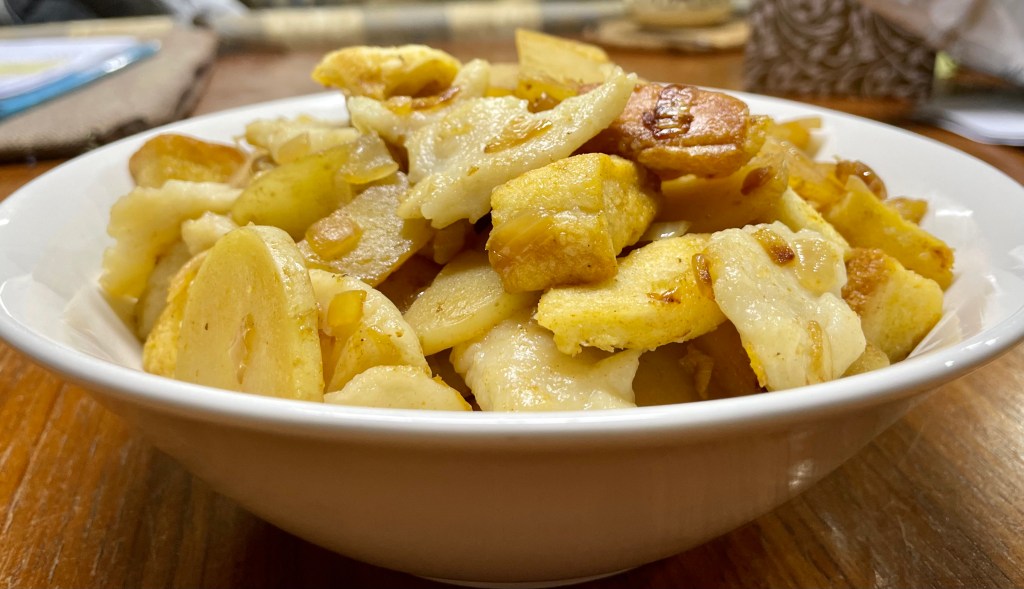
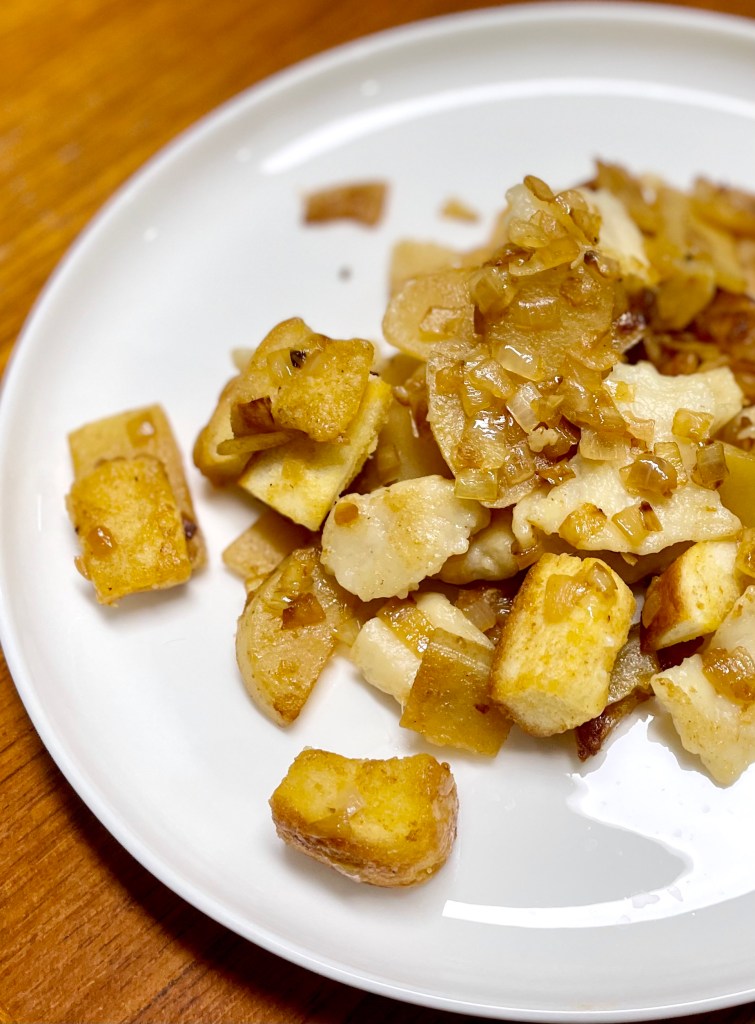
Taiwanese crystal dumplings have an outer casing that’s made with potato starch which becomes translucent when the dumplings cool down after being cooked (hence “crystal”). The starch gives it a distinct chewy texture. The casing itself doesn’t have much flavour but serves more as a textural component. The real flavour is in the pork filling which is sautéed in fried shallots and soy sauce, making a little flavour bomb. The intensity of the flavours in the filling carries the bland casing with it to create a wonderful balanced mouthful of savoury chewy goodness. There are multiple ways to eat a crystal dumping. My favourite way is to have it in a bowl of warm chicken soup with fried shallots but you can also eat it on its own or throw it in a hotpot. Scroll to the end of the recipe and I’ll show you how to eat them in different ways! I’ll be uploading a video on how to make them shortly so keep an eye out!

Anyways, thanks for reading my story and without further ado, here’s the recipe! If you have any comments or suggestions, I’d love to hear from you in the comment section! You can follow me on instagram, youtube and facebook to see all the recipes I post!

Happy cooking!

Ingredients you’ll need:

  • Filling:
    • 200g pork mince
    • 1 1/2 Tbsps soy sauce
    • 1 1/2 Tbsps fried shallots
    • 1/2 tsp ground white pepper
  • Crystal Dumpling Skin:
    • 1 cup (165g) potato starch
    • 1/4 cup boiling water
    • 3 Tbsps (45ml) cold water + more if needed
    • 2 tsp sesame oil
  • Bowl of cold water + 2 tsp sesame oil

Directions:

Make the filling: Heat a skillet over MED-HIGH heat and sauté 1/3 of the pork mince in some oil until cooked through. Add in the soy sauce and stir until fragrant. Turn off the heat and mix in the fried shallots.

Put all the contents from the skillet in a large bowl and mix in the remaining pork mince and white pepper to the bowl. You should now have a sticky filling mixture. Set aside.

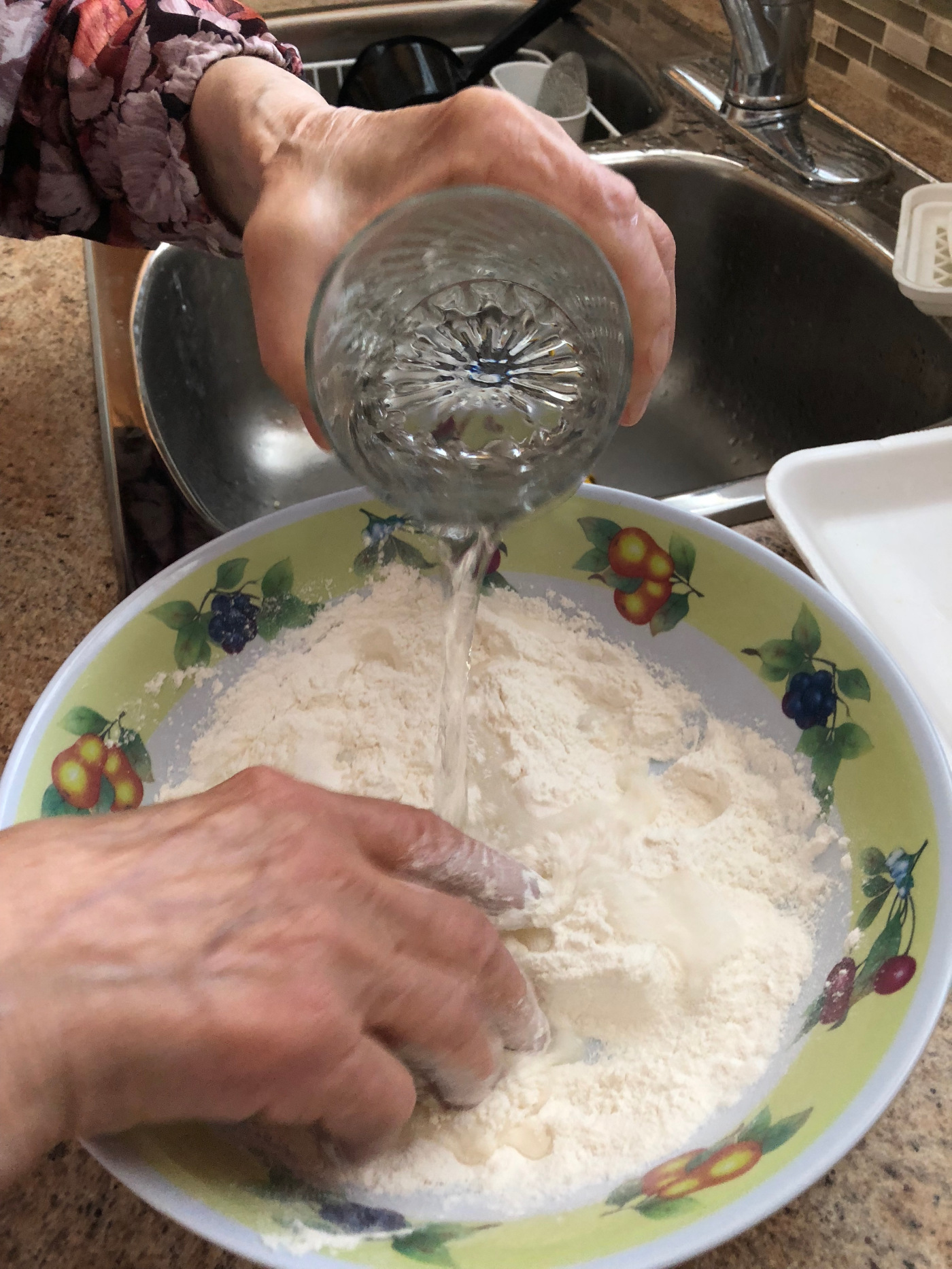
Make the dumpling wrappers: In a wide base bowl (you want a wider base for a bigger surface area), add in potato starch and pour the boiling water over the potato starch and mix with a spatula until combined/clumped together. When the dough is cool enough to handle, continue mixing with your hands. THIS STEP IS CRUCIAL! The boiling water cooks the starch and it’s what gives the dumpling the chewy texture so you want to mix it all together as best as you can before adding the cold water. Once you’ve mixed it as well as you can (you’ll end up with a rough dry dough (second photo)), add in the cold water 1/3 at a time while using your hands to mix the dough until you get a smooth ball (you might not need all of the water, just add enough until it’s smooth). Roll the dough around the bowl to ensure you’ve incorporated all of the potato starch into the dough. Add in 2 tsps of sesame oil and mix it into the dough. You should have a smooth, easily pliable dough ball similar to soft play-doh.

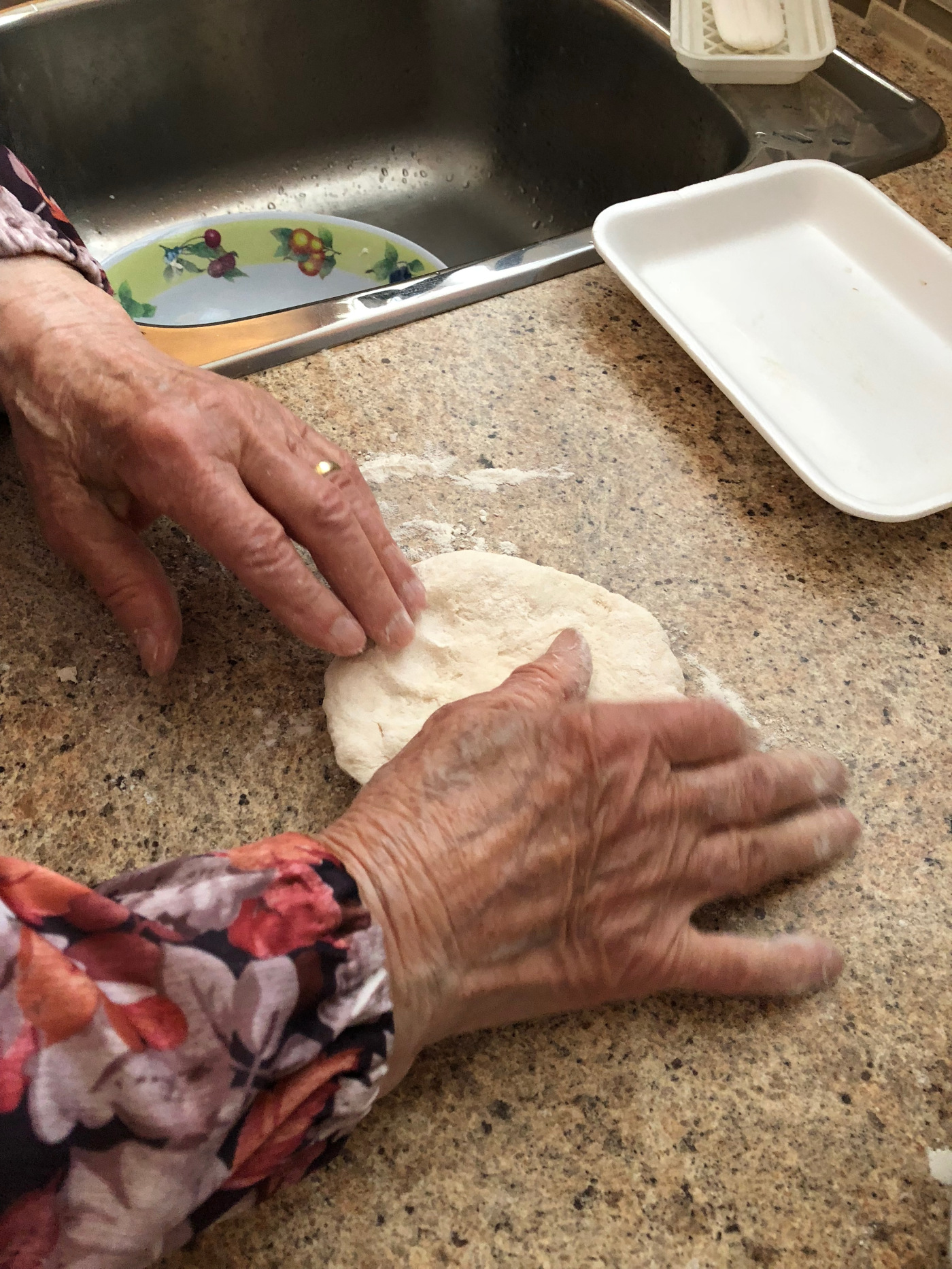
Oil your hands and roll the dough out into a roll and cut it into 24 equal pieces (you can keep dividing the dough into halves until you reach 24 pieces). Then using your hands, flatten each small dough ball into a flat pancake roughly 2-3mm thick and place 1 tsp of filling in the middle. Bring the edges together to form a triangle shape and press together the edges to seal it.

Tips:

  • Be careful not to overfill the dumplings! This dough is not like typical dumpling dough and does not stretch well – it can easily break if you stretch it too much or overfill the dumplings. If you can see the filling through the skin, you’ve stretched it too much and it will have a higher chance of breaking while cooking.
  • If you’re worried you’re wrapping them too thin or thick, you can always wrap a few and cook them first as a test to see if the thickness is right for you.
  • While you’re wrapping the dumplings, keep the rest of the dough covered so it doesn’t dry out. By keeping your hands oiled during the wrapping process it helps keep the dough moist and easier to work with.

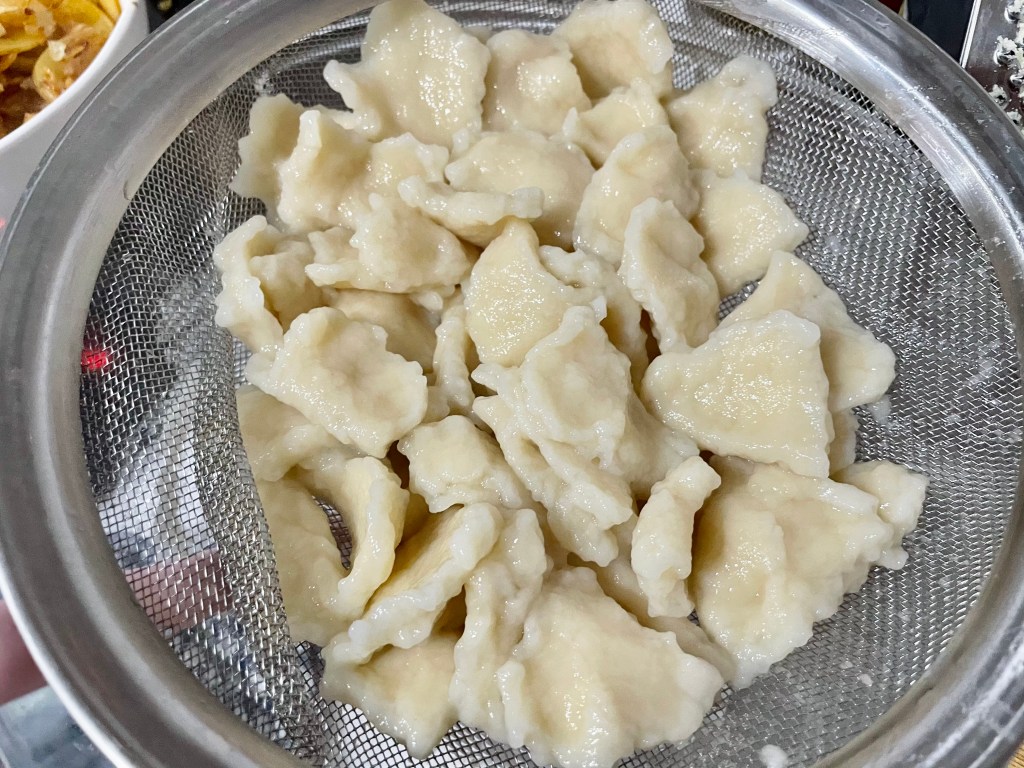
Cook the Dumplings: Once you’ve finished wrapping all your dumplings, bring a pot of water to a hard boil and gently drop the dumplings in one at a time. Traditionally when dumplings float to the top they’re considered cooked, however with these dumplings I found that they need a little longer to cook the skin to get the ultimate chewy texture. These dumplings will pretty much float to the top in the first 30 seconds, but they aren’t done cooking until the skin looks a little puffy/squishy and the edges are a little translucent (see photo above – it’s hard to describe it!), ~5-8 mins to cook.

Strain from the hot water and dunk them into a bowl of cold water with sesame oil (the oil stops them from sticking together and the cold water stops the cooking process, firms up the skin, and also makes the dumplings more translucent). When cooled, drain them (don’t let them soak for too long in the water or they can get soggy and fall apart).

Choose Your Eating Adventure:

In a broth (my favourite way!!): Add some fried shallots and chopped spring onion to a bowl and pour hot chicken stock into the bowl, topped with a few dumplings and serve. You can also add in some noodles and shredded chicken if you like to make it a full meal.

Eaten alone: If the dumplings have cooled, put them in a pot of boiling water to warm them up and then drain and serve with any sauce you like. Lao gan ma crispy chilli oil would be my go-to choice! You can alternatively also eat them directly as they come out of the pot after boiling instead of dunking them in cold water but make sure you add some sesame oil on them or else they’ll stick together when you serve it.

Storage: Drain the dumplings well and place them in a plastic bag with a teaspoon of sesame oil and mix them around. You can refrigerate them in the bag for a few days but I’d recommend eating them soon

In a hotpot: Dump them directly in your hotpot soup! They only take a couple minutes to warm up and be ready to eat.

Summarized Recipe:

Taiwanese Crystal Dumplings 水晶饺 (Shuĭ Jing Jiao)

Date Published: August 9th, 2020 | Last Updated: August 9th, 2020
Author: Abby |Category: asian, mains, easy, soups
Serves: 24 dumplings | Prep time: 30 mins | Cook time: 10 mins

Ingredients:

  • Filling:
    • 200g pork mince
    • 1 1/2 Tbsps soy sauce
    • 1 1/2 Tbsps fried shallots
    • 1/2 tsp ground white pepper
  • Crystal Dumpling Skin:
    • 1 cup (165g) potato starch
    • 1/4 cup boiling water
    • 3 Tbsps (45ml) cold water + more if needed
    • 2 tsp sesame oil
  • Bowl of cold water + 2 tsp sesame oil

Directions:

  1. Make the filling: Heat a skillet over MED-HIGH heat and sauté 1/3 of the pork mince in some oil until cooked through. Add in the soy sauce and stir until fragrant. Turn off the heat and mix in the fried shallots. Put all the contents from the skillet in a large bowl and mix in the remaining pork mince and white pepper to the bowl. You should now have a sticky filling mixture. Set aside.
  2. Make the dumpling wrappers: In a wide base bowl, add in potato starch and pour the boiling water over the potato starch and mix with a spatula until combined/clumped together. When the dough is cool enough to handle, continue mixing with your hands to pick up as much starch as possible (you’ll end up with a rough dry crumbly dough (see photo above) – THIS STEP IS CRUCIAL! Next add in the cold water 1/3 at a time while using your hands to mix the dough until you get a smooth ball (you might not need all of the water, just add enough until it’s smooth). Roll the dough around the bowl to ensure you’ve incorporated all of the potato starch into the dough. Add in 2 tsps of sesame oil and mix it into the dough. You should have a smooth, easily pliable dough ball similar to soft play-doh.
  3. Oil your hands and roll the dough out into a roll and cut it into 24 equal pieces. Then using your hands, flatten each small dough ball into a flat pancake roughly 2-3mm thick and place 1 tsp of filling in the middle. Bring the edges together to form a triangle shape and press together the edges to seal it (see tips and photos above). Don’t overfill or stretch them too much and keep your remaining dough under cover so it doesn’t dry out.
  4. Cook the Dumplings: Once you’ve finished wrapping all your dumplings, bring a pot of water to a hard boil and gently drop the dumplings in one at a time. They’re done when the skin looks a little puffy/squishy and the edges are a little translucent (see photo above – it’s hard to describe it!), ~5-8 mins to cook.
  5. Strain from the hot water and dunk them into a bowl of cold water with sesame oil. When cooled, drain them (don’t let them soak for too long in the water or they can get soggy and fall apart).

Choose Your Eating Adventure:

  • In a broth (my favourite way!!): Add some fried shallots and chopped spring onion to a bowl and pour hot chicken stock into the bowl, topped with a few dumplings and serve. You can also add in some noodles and shredded chicken if you like to make it a full meal.
  • Eaten alone: If the dumplings have cooled, put them in a pot of boiling water to warm them up and then drain and serve with any sauce you like. Lao gan ma crispy chilli oil would be my go-to choice! You can alternatively also eat them directly as they come out of the pot after boiling instead of dunking them in cold water but make sure you add some sesame oil on them or else they’ll stick together when you serve it.
  • Storage: Drain the dumplings well and place them in a plastic bag with a teaspoon of sesame oil and mix them around. You can refrigerate them in the bag for a few days.
  • In a hotpot: Dump them directly in your hotpot soup! They only take a couple minutes to warm up and be ready to eat.

Parmesan-Crusted Cauliflower Steak


Date Published: August 8th, 2020 | Last Updated: August 8th, 2020
Author: Abby |Category: vegetarian, mains, sides, healthy
Serves: 4 | Prep time: 10 mins | Cook time: 38 mins

Jump to recipe |

Ohhhhh boy. Get ready to have your mind blown. I had never heard of cauliflower steak before until a few weeks ago when the whole family was trying to eat a little lighter. After a couple hours of googling for some food inspo, I came across this recipe from Epicurious and I instantly knew we had to make it. The result came out fantastic albeit a little salty (and I usually love my salt so that’s saying something!). The crunchy parmesan panko crust with the dijon mayo ontop of the roasted cauliflower was so delicious and adds warmth to a miserable cold day (much like today). This easy recipe is definitely a must-try! It’s going straight up to my top 20 dishes to make! I’ve adjusted the recipe to lessen the salt and made some adjustments to have this as a standalone dish with any sides of your choice.

PS: Try to get the biggest cauliflower you can find because I could eat two of these in one sitting! Or make smaller steaks and serve this as a side dish.

Anyways, without further ado, here’s the recipe! If you have any comments or suggestions, I’d love to hear from you in the comment section! You can follow me on instagram, youtube and facebook to see all the recipes I post!

Happy cooking!

Ingredients you’ll need:

  • 2 large heads of cauliflower
  • 1/2 tsp fresh ground black pepper
  • 3 Tbsps mayonnaise
  • 1 tsp dijon mustard
  • 1/2 tsp sugar
  • Parmesan Crust Topping:
    • 3 garlic cloves, minced
    • Zest of 1 lemon (~1 Tbsp)
    • 1/3 cup fresh parsley, chopped finely
    • 1/2 cup parmesan cheese, grated
    • 6 Tbsps olive oil
    • 2/3 cup panko (Japanese breadcrumbs)

Directions:

Preheat oven to 220˚C (425 F).

Remove the outer leaves of your cauliflower heads and keep the core intact. If the bottom of the core is thick and fibrous, you can trim it off. Cutting along the widest part of the cauliflower (so you get the biggest slices), cut the cauliflower in half then slice one 3cm thick cuts from each half. Reserve the rest of the cauliflower to be used another day. Repeat for the second cauliflower.

Gently rub olive oil over and black pepper to both sides of the steaks and bake for 10-15 minutes on each side at 220˚C. You want the cauliflower to be tender and browned on the edges.

While the cauliflower is baking, combine the mayonnaise, dijon mustard and sugar in a small bowl and set aside.

In another bowl combine all the ingredients of the parmesan crust in a bowl except panko (garlic, lemon zest, parsely, parmesan, olive oil) and set aside. Don’t add the panko to this mixture until your cauliflower has cooked and you’re ready to use it, otherwise the panko can get a little soggy sitting in the bowl.

Once the cauliflower steaks have cooked on both sides, take it out of the oven and spread the mayonnaise/dijon mixture over each steak. Add panko to the parmesan crust mixture and combine then spread it ontop of the steaks. Bake the steaks for another 5-7 minutes until the panko crust is lightly browned. Serve!

Summarized Recipe:

Parmesan-Crusted Cauliflower Steak

Date Published: August 8th, 2020 | Last Updated: August 8th, 2020
Author: Abby |Category: vegetarian, mains, sides, healthy
Serves: 4 | Prep time: 10 mins | Cook time: 38 mins

Ingredients:

  • 2 large heads of cauliflower
  • 1/2 tsp fresh ground black pepper
  • 3 Tbsps mayonnaise
  • 1 tsp dijon mustard
  • 1/2 tsp sugar
  • Parmesan Crust Topping:
    • 3 garlic cloves, minced
    • Zest of 1 lemon (~1 Tbsp)
    • 1/3 cup fresh parsley, chopped finely
    • 1/2 cup parmesan cheese, grated
    • 6 Tbsps olive oil
    • 2/3 cup panko (Japanese breadcrumbs)

Directions:

  1. Preheat oven to 220˚C (425 F).
  2. Remove the outer leaves of your cauliflower heads and keep the core intact. If the bottom of the core is thick and fibrous, you can trim it off. Cutting along the widest part of the cauliflower (so you get the biggest slices), cut the cauliflower in half then slice one 3cm thick cuts from each half. Reserve the rest of the cauliflower to be used another day. Repeat for the second cauliflower.
  3. Gently rub olive oil over and black pepper to both sides of the steaks and bake for 10-15 minutes on each side at 220˚C. You want the cauliflower to be tender and browned on the edges.
  4. While the cauliflower is baking, combine the mayonnaise, dijon mustard and sugar in a small bowl and set aside.
  5. In another bowl combine all the ingredients of the parmesan crust in a bowl except panko (garlic, lemon zest, parsely, parmesan, olive oil) and set aside. Don’t add the panko to this mixture until your cauliflower has cooked and you’re ready to use it, otherwise the panko can get a little soggy sitting in the bowl.
  6. Once the cauliflower steaks have cooked on both sides, take it out of the oven and spread the mayonnaise/dijon mixture over each steak. Add panko to the parmesan crust mixture and combine then spread it ontop of the steaks. Bake the steaks for another 5-7 minutes until the panko crust is lightly browned. Serve!

Taiwanese Cold Noodles 涼麵 (Liang Mian)


Date Published: August 7th, 2020 | Last Updated: August 7th, 2020
Author: Abby |Category: asian, mains, easy, vegetarian
Serves: 4 | Prep time: 10 mins | Cook time: 2 mins + time to cook noodles

Jump to recipe |

If you’ve ever been to Taiwan in the middle of summer, you’ll know that not only does it get hot, it gets HUMID AF. What’s better on a hot sticky day than a refreshing bowl of cold noodles? This dish is commonly found everywhere in Taiwan – you can even pick them up from most convenience stores, pre-packaged in a lunch box and ready to eat – just add the sauce! The direct translation of “liang mian” is “chilled” or “cold” noodles and it’s served as a bowl of cold white noodles mixed with a savoury peanut sauce and topped with cucumber and carrot slices, occasionally a sliced egg. It’s delicious, filling and crazy easy to make! It’s also a great lunch to pack to eat on the go or to avoid the microwave queues at work or school 😉.

Anyways, without further ado, here’s the recipe! If you have any comments or suggestions, I’d love to hear from you in the comment section! You can follow me on instagram, youtube and facebook to see all the recipes I post!

Happy cooking!

Ingredients you’ll need:

  • Sauce:
    • 6 Tbsps crunchy peanut butter (smooth is okay too but crunchy gives it better texture)
    • 2 Tbsp soy sauce
    • 2 tsp garlic, minced
    • 2 tsp sugar
    • 2 tsp black vinegar
    • 1 tsp sesame oil
    • 3 Tbsps warm water (or more)
  • White Noodles (any brand you like)
  • 1 Tbsp sesame oil
  • 1 cucumber, julienned
  • 1 carrot, julienned

Directions:

Make the sauce by combining all the sauce ingredients together except for the water. Once combined, add 1 Tbsp of warm water at a time to the sauce and mix until you get a thin runny sauce but not overly watery (only add as much water as you need).

Make the noodles according to package instructions. Drain well and rinse under cold running water until the noodles are cooled. Drizzle 1 Tbsp of sesame oil on the noodles and mix it around so they don’t stick together.

Assemble the noodles by adding the sauce to the noodles with the cucumber and carrots. Mix until combined. Taste and adjust flavours as needed. If you’ve made too many noodles (as I always do because I’m terrible at judging how much noodles to cook), make more sauce for the noodles until you’re happy with the intensity of the flavours. Serve cold!

Tip: If you’re making this ahead of time, I’d suggest you pack the sauce separately and pour it on the noodles when you’re ready to eat to avoid the noodles getting too soft from sitting in sauce for too long.

Summarized Recipe:

Taiwanese Cold Noodles 涼麵 (Liang Mian)

Date Published: August 7th, 2020 | Last Updated: August 7th, 2020
Author: Abby |Category: asian, mains, easy, vegetarian
Serves: 4 | Prep time: 10 mins | Cook time: 2 mins + time to cook noodles

Ingredients:

  • Sauce:
    • 6 Tbsps crunchy peanut butter (smooth is okay too but crunchy gives it better texture)
    • 2 Tbsp soy sauce
    • 2 tsp garlic, minced
    • 2 tsp sugar
    • 2 tsp black vinegar
    • 1 tsp sesame oil
    • 3 Tbsps warm water (or more)
  • White Noodles (any brand you like)
  • 1 Tbsp sesame oil
  • 1 cucumber, julienned
  • 1 carrot, julienned

Directions:

  1. Make the sauce by combining all the sauce ingredients together except for the water. Once combined, add 1 Tbsp of warm water at a time to the sauce and mix until you get a thin runny sauce but not overly watery (only add as much water as you need).
  2. Make the noodles according to package instructions. Drain well and rinse under cold running water until the noodles are cooled. Drizzle 1 Tbsp of sesame oil on the noodles and mix it around so they don’t stick together.
  3. Assemble the noodles by adding the sauce to the noodles with the cucumber and carrots. Mix until combined. Taste and adjust flavours as needed. Serve cold!
    • If you’ve made too many noodles (as I always do because I’m terrible at judging how much noodles to cook), make more sauce for the noodles until you’re happy with the intensity of the flavours.

Tip: If you’re making this ahead of time, I’d suggest you pack the sauce separately and pour it on the noodles when you’re ready to eat to avoid the noodles getting too soft from sitting in sauce for too long.

Thai Green Curry (Chicken, Beef, Fish or Veg)


Date Published: August 5th, 2020 | Last Updated: August 5th, 2020
Author: Abby |Category: mains, asian, < 30mins
Serves: 4-6 | Prep time: 15 mins | Cook time: 20 mins

Jump to recipe |

I can never pass up a good curry no matter the cuisine. I just love the creaminess and the intense flavours. Thai curries hold a special place in my belly, especially the green curry. The green colour comes from the use of the milder green chilli pepper, kaffir lime, cilantro/coriander and sometimes basil. I love the aroma and the fact that I can pack it full of veggies and have it all swim around in the aromatic coconut sauce.

Although the flavours are complex, making a Thai curry is actually really straight forward and simple as long as you have the green curry paste, which is where most of the flavour (and effort) comes from. I was surprised how quickly it all came together when I made it for the first time. You can buy pretty decent packaged Thai curry pastes from pretty much any supermarket these days and for pretty cheap too, but if you’re like me and have the need to conquer seemingly complex recipes, you can make your own with the green curry paste recipe. I’ve written this recipe for the intention of using the homemade curry paste, however if you want to use the canned pastes, you’ll have to “freshen” it up by sautéing in some garlic and ginger to bring the flavours out.

This recipe is easily customizable with any veggies and protein you like and in any proportion. I’ve written it based on my favourite veg to put in this curry but feel free to change it up to your liking. The beauty of this curry is that because of its strong flavours, you can also put in whatever protein you like. I’ve colour-coded the recipes so it’s easier to follow if you want to make chicken, beef or fish. The other great thing about this recipe is that it’s all done in one pot so there’s minimal clean up!

Anyways, without further ado, here’s the recipe! If you have any comments or suggestions, I’d love to hear from you in the comment section! You can follow me on instagram, youtube and facebook to see all the recipes I post!

Happy cooking!

Ingredients you’ll need:

  • 1.5 Tbsp coconut oil
  • Meat of choice: (optional)
    • Chicken: 400g (~4) skinless boneless chicken thighs (or breast), diced into bite-sized pieces or sliced thinly (depending on how you like it)
    • Beef: 400g, sliced thinly. Any steak cut will be good.
    • Fish: 400g, diced into chunks. Use whatever fish you like. I tend to like using salmon or a white fish.
    • Vegetarian: no need for meat, just add more veggies!
  • 1 Tbsp coconut oil
  • 3/4 cup homemade Thai green curry paste (click link for recipe)
    • Please note: this recipe was written to be used with the homemade Thai green curry paste. If you want to use canned Thai green curry paste (Maesri is the go-to brand), you’ll need to “freshen” up the paste to bring out more flavour by sautéing one can (114g) it in 3 cloves of garlic and 2 Tbsps of minced ginger. I do recommend making the curry paste yourself if you’ve got time – it’s so much more aromatic.
  • 1 cup chicken stock (or vegetable stock)
  • 800ml (2 cans) coconut milk
  • Any veggies you like in your curry. I’ve written this recipe based on my favourite veg, but feel free to change it up and do you. Just keep in mind their proportions to the chicken, otherwise you may end up with a veggie curry (which is fine too if you prefer less chicken). These are what I usually add:
    • 1 1/2 cups King oyster mushrooms, roughly chopped
    • 1 1/2 cups green beans, trimmed and snapped in halves
    • 1 cup baby corn
    • 1 1/2 cups eggplant, diced and seared first for extra flavour
    • 1 1/2 cups red bell peppers/capsicum, chopped
    • 10 Thai basil leaves
  • 1/2 Tbsp fish sauce (or more to taste)
  • Sea salt + black pepper to taste
  • Sugar to taste

Directions:

Prepare your protein (if using):

If using chicken:

In medium pot on MED-HIGH heat melt the coconut oil and add in the chicken pieces (you may have to do this in batches if they’re too crowded – see tip*) and cook until lightly brown on the outside. Don’t worry about it cooking all the way through – it will finish cooking in the curry.

*Tip: You want to put the chicken pieces in the pot in a single layer to sear the outside. If you overcrowd the chicken or are overlapping them, you will likely have too much liquid released and end up boiling the chicken. Depending on the size of your pot, you may have to cook it in 2 or 3 batches.

After you’ve browned all the chicken pieces, remove them from the pot and set aside.

If using beef:

In medium pot on MED-HIGH heat melt the coconut oil and add in the beef pieces and quickly cook for a few minutes until lightly brown on the outside. Don’t worry about it cooking all the way through – it will finish cooking in the curry.

After you’ve browned all the beef pieces, remove them from the pot and set aside.

If using fish:

You don’t need to do any cooking beforehand. Just have it cut up in bite-sized pieces and add it later on with the veggies.

In the same pot still on MED-HIGH heat, discard any excess liquids and melt 1 Tbsp coconut oil. Add the green curry paste and stir for a few minutes to toast the paste. When the excess liquid has evaporated and you’re left with a semi-dry paste (see photo above), add in the chicken stock and coconut milk. Reduce the heat to MED, put a lid on and let the mixture simmer for 5 minutes.

Add in your veggies and chicken, beef or fish and continue to cook the curry without the lid for another 5 minutes or until all your protein and veg have cooked. Add in the fish sauce. Taste and adjust flavours as needed. If not salty enough add more salt, add sugar if not sweet enough. Serve!

Tip: If you want to turn this into a soup, add in 1 extra cup (250ml) of chicken stock. Feel free to add in some noodles too!

Summarized Recipe:

Thai Green Curry (Chicken, Beef, Fish or Veg)

Date Published: August 5th, 2020 | Last Updated: August 5th, 2020
Author: Abby |Category: mains, asian, < 30mins
Serves: 4-6 | Prep time: 15 mins | Cook time: 20 mins

Ingredients:

  • 1.5 Tbsp coconut oil
  • Meat of choice:
    • Chicken: 400g (~4) skinless boneless chicken thighs (or breast), diced into bite-sized pieces or sliced thinly (depending on how you like it)
    • Beef: 400g, sliced thinly. Any steak cut will be good.
    • Fish: 400g, diced into chunks. Use whatever fish you like. I tend to like using salmon or a white fish.
    • Vegetarian: no need for meat, just add more veggies!
  • 1 Tbsp coconut oil
  • 3/4 cup homemade Thai green curry paste (click link for recipe)
    • Please note: this recipe was written to be used with the homemade Thai green curry paste. If you want to use canned Thai green curry paste (Maesri is the go-to brand), you’ll need to “freshen” up the paste to bring out more flavour by sautéing one can (114g) it in 3 cloves of garlic and 2 Tbsps of minced ginger. I do recommend making the curry paste yourself if you’ve got time – it’s so much more aromatic.
  • 1 cup (250ml) chicken stock (or vegetable stock)
  • 800ml (2 cans) coconut milk
  • Any veggies you like in your curry. I’ve written this recipe based on my favourite veg, but feel free to change it up and do you. Just keep in mind their proportions to the chicken, otherwise you may end up with a veggie curry (which is fine too if you prefer less chicken). These are what I usually add:
    • 1 1/2 cups King oyster mushrooms, roughly chopped
    • 1 1/2 cups green beans, trimmed and snapped in halves
    • 1 cup baby corn
    • 1 1/2 cups eggplant, diced and seared first for extra flavour
    • 1 1/2 cups red bell peppers/capsicum, chopped
    • 10 Thai basil leaves
  • 1/2 Tbsp fish sauce (or more to taste)
  • Sea salt + black pepper to taste
  • Sugar to taste

Directions:

  1. Prepare your protein (if using):
    • If using chicken:
      1. In medium pot on MED-HIGH heat melt the coconut oil and add in the chicken pieces (you may have to do this in batches if they’re too crowded – see tip*) and cook until lightly brown on the outside. Don’t worry about it cooking all the way through – it will finish cooking in the curry.
        • *Tip: You want to put the chicken pieces in the pot in a single layer to sear the outside. If you overcrowd the chicken or are overlapping them, you will likely have too much liquid released and end up boiling the chicken. Depending on the size of your pot, you may have to cook it in 2 or 3 batches.
      2. After you’ve browned all the chicken pieces, remove them from the pot and set aside.
    • If using beef:
      1. In medium pot on MED-HIGH heat melt the coconut oil and add in the beef pieces and quickly cook for a few minutes until lightly brown on the outside. Don’t worry about it cooking all the way through – it will finish cooking in the curry.
      2. After you’ve browned all the beef pieces, remove them from the pot and set aside.
    • If using fish:
      • You don’t need to do any cooking beforehand. Just have it cut up in bite-sized pieces and add it later on with the veggies.
  2. In the same pot still on MED-HIGH heat, discard any excess liquids and melt 1 Tbsp coconut oil. Add the green curry paste and stir for a few minutes to toast the paste. When the excess liquid has evaporated and you’re left with a semi-dry paste, add in the chicken stock and coconut milk. Reduce the heat to MED, put a lid on and let the mixture simmer for 5 minutes.
  3. Add in your veggies and chicken, beef or fish and continue to cook the curry without the lid for another 5 minutes or until all your protein and veg have cooked. Add in the fish sauce. Taste and adjust flavours as needed. If not salty enough add more salt, add sugar if not sweet enough. Serve!

Tip: If you want to turn this into a soup, add in 1 extra cup (250ml) of chicken stock. Feel free to add in some noodles too!

Chicken Udon Stir-Fry


Date Published: August 4th, 2020 | Last Updated: August 4th, 2020
Author: Abby |Category: healthy, asian, mains
Serves: 4-6 | Prep time: 15 mins | Cook time: 20 mins

Jump to recipe |

Japanese udon is one of my favourite type of noodles. There’s so much chew compared to regular noodles and makes it more satisfying to eat. This is a quick and easy stir-fry packed with chicken, cabbage, carrots and udon noodles. The crunchy cabbage and carrots with the chewiness of the udon cooked in a savoury sauce makes this dish so yum and healthy too!

This was actually one of the first things Toby made for me when we were in Bairnsdale together on a vet student placement. We agreed that we’d both start eating healthier and he surprised me with this dinner when I came home from my shift. It was the best thing to come home to especially after a long cold day. ❤️

Anyways, without further ado, here’s the recipe! If you have any comments or suggestions, I’d love to hear from you in the comment section! You can follow me on instagram, youtube and facebook to see all the recipes I post!

Happy cooking!

Ingredients you’ll need:

  • 500g udon noodles, cooked and drained
  • 1/3 cup light soy sauce
  • 1 Tbsp soy sauce
  • 1/3 cup mirin
  • 2 Tbsps ketchup
  • 1 Tbsp caster sugar
  • 1 Tbsp vegetable oil
  • 3 garlic cloves, minced
  • 3cm piece of ginger, peeled and minced
  • 1 large (2.5 cups) brown onions, diced
  • 500g chicken mince (or pork mince)
  • 1/4 small green cabbage, diced to 2cm pieces
  • 2 large carrots, julienned or chopped finely
  • 2 Tbsps sesame oil, to drizzle
  • White sesame seeds, to sprinkle

Directions:

If you haven’t prepared you udon noodles yet, cook them according to package instructions, then drain and rinse the noodles under cold water. Set aside.

In a small bowl, make the sauce by combining: soy sauce, light soy sauce, mirin, ketchup, and sugar. Don’t worry if you have small clumps in the sauce.

Heat up a wok over high heat and add 1 Tbsp of vegetable oil and sauté the garlic, ginger and onion (in that order) for a few minutes until the onion starts to turn translucent.
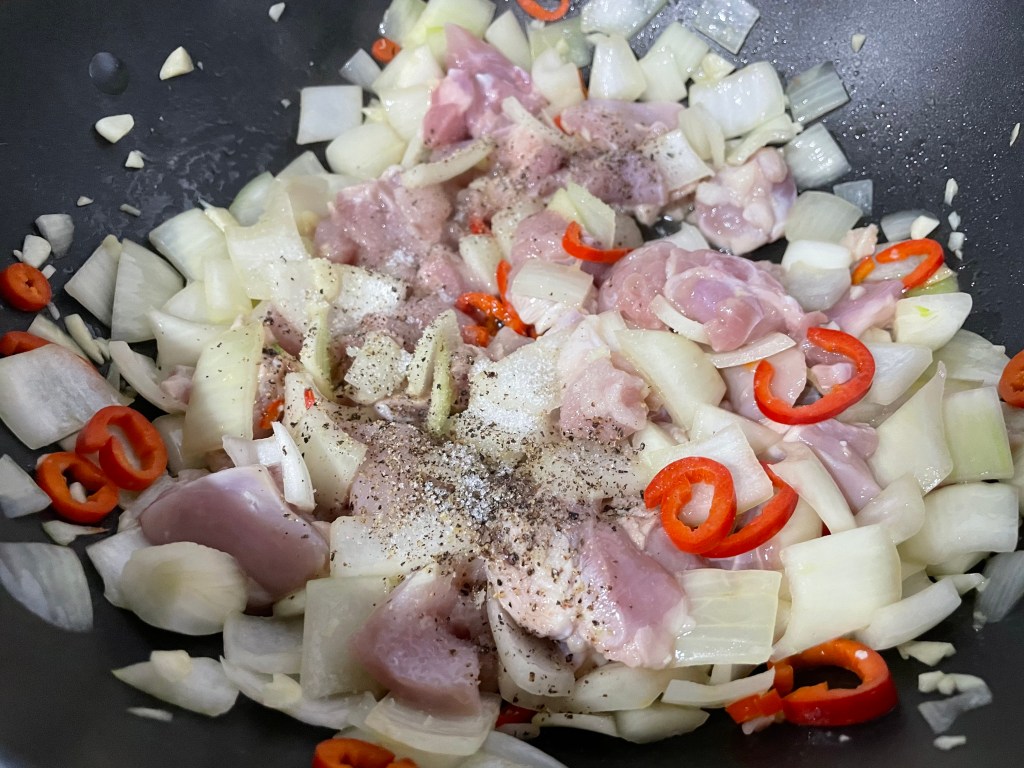
Add the chicken mince to the wok and use your spatula to break up any lumps and sauté it until the chicken is mostly browned. (You do not have to cook the mince all the way through. It will finish cooking as you add the other ingredients in).

Add the cabbage and carrot to the wok. Sauté for another few minutes until the cabbage is wilted.

Add in the noodles and the sauce. Mix until combined and most of the liquids have cooked off. Turn heat off, drizzle sesame oil over the noodles and mix.

Serve noodles out and sprinkle sesame seeds over top. Enjoy!

Summarized Recipe:

Chicken Udon Stir-Fry

Date Published: August 4th, 2020 | Last Updated: August 4th, 2020
Author: Abby |Category: healthy, asian, mains
Serves: 4-6 | Prep time: 15 mins | Cook time: 20 mins

Ingredients:

  • 500g udon noodles, cooked and drained
  • 1/3 cup light soy sauce
  • 1 Tbsp soy sauce
  • 1/3 cup mirin
  • 2 Tbsps ketchup
  • 1 Tbsp caster sugar
  • 1 Tbsp vegetable oil
  • 3 garlic cloves, minced
  • 3cm piece of ginger, peeled and minced
  • 1 large (2.5 cups) brown onions, diced
  • 500g chicken mince (or pork mince)
  • 1/4 small green cabbage, diced to 2cm pieces
  • 2 large carrots, julienned or chopped finely
  • 2 Tbsps sesame oil, to drizzle
  • White sesame seeds, to sprinkle

Directions:

  1. If you haven’t prepared you udon noodles yet, cook them according to package instructions, then drain and rinse the noodles under cold water. Set aside.
  2. In a small bowl, make the sauce by combining: soy sauce, light soy sauce, mirin, ketchup, and sugar.
  3. Heat up a wok over high heat and add 1 Tbsp of vegetable oil and sauté the garlic, ginger and onion (in that order) for a few minutes until the onion starts to turn translucent.
  4. Add the chicken mince to the wok and use your spatula to break up any lumps and sauté it until the chicken is mostly browned. (You do not have to cook the mince all the way through. It will finish cooking as you add the other ingredients in).
  5. Add the cabbage and carrot to the wok. Sauté for another few minutes until the cabbage is wilted.
  6. Add in the noodles and the sauce (made in step 2). Mix until combined and most of the liquids have cooked off. Turn heat off, drizzle sesame oil over the noodles and mix.
  7. Serve noodles out and sprinkle sesame seeds over top. Enjoy!

Legit Vietnamese Pho


Date Published: August 3rd, 2020 | Last Updated: Jan 5th, 2025
Author: Abby |Category: asian, mains, soup
Serves: 4-6 | Prep time: 20 mins | Cook time: 4-8 hours

Jump to recipe |

Pho (pronounced ‘fuh’) is a traditional Vietnamese dish. It’s a delicious flavourful beef (or chicken) broth stewed for hours and served with rice vermicelli, bean sprouts, Thai basil, and beef slices. It’s not super traditional, but I always eat pho with a HEALTHY amount of hoisin sauce. I had a friend put hoisin directly into the broth, but I like to make a perfect spoonful of broth, noodles and then dip a slice of beef in hoisin sauce and eat it all in one delicious bite. The beef slices are usually served raw and the hot broth cooks it when ladled into the bowl. [Side story: Every time I order pho, my mother would always immediately tell me to quickly dunk the beef slices and bean sprouts to the bottom of the bowl so it can cook right away before the broth cools. We’ve ordered this dish for years and she’ll still say it every time without fail – now I hear this every time I eat pho.] You can order other versions of pho served with chicken, pork balls, brisket, tripe…etc, but raw beef pho will always be my go-to.

Side story: Pho is very nostalgic for me. When my family immigrated to Canada, my parents made my siblings and I go to “Chinese school” every Saturday morning continue our Asian studies. I hated going. The school was nearly an hour drive away and we had to get up crazy early every Saturday morning for 3 hours of lessons. Class finished at 12pm and I was always SO hungry counting down the hours until lunch. The only good thing about driving so far was the food afterwards. In our hometown there wasn’t a very big Asian population, which translates to not a lot of good Asian food – but in Mississauga (the city where the classes were), the majority of the population was Asian which meant legit good Asian food EVERYWHERE. We’d most often go to this Vietnamese restaurant in a shopping mall where my mom would pick up some groceries and a free weekly Chinese newspaper. Their pho was insanely good and they had melt-in-your-mouth brisket. I’d always forget to ask for no coriander so I would spend 15 minutes picking out every little piece of finely chopped coriander before I would start eating – but it was worth it even if my soup was a little cold. A few years later a Vietnamese restaurant opened up near our home and we pretty much went there all the time – what’s even better was that there as also an Asian grocer in the mall where my mom could continue to do her shopping and get her weekly Chinese newspaper. Now that we’ve all gone our separate ways, every time I eat pho it transports me back to those days with my family.

Strap in, because this soup takes a long time to make. The majority of the work is waiting to let the soup simmer but the actual process is really quite easy. The longer you cook the soup, the stronger the flavours will be. I’d recommend even starting this recipe the evening before and let it simmer overnight so it’ll be ready for lunch the next day (warning: make this on a full stomach because the amazing aromas of this soup will make you hangry). There are lots of quick shortcut versions of this soup out there, but I feel like I won’t do this dish justice if I don’t put in the extra effort and make it legit for maximum flavour. I’ve adapted this recipe from RecipeTinEats and made some changes in regards to ingredients and cooking times, but the gist of it is similar.

Anyways, without further ado, here’s the recipe! If you have any comments or suggestions, I’d love to hear from you in the comment section! You can follow me on instagram, youtube and facebook to see all the recipes I post!

Happy cooking!

Ingredients you’ll need:

Beef Mix: You’ll need a good mix of beef meat and bones to create the wonderful flavours of the broth. Each type of beef has their role:

  • 2kg beef brisket – the most important player which adds the most beef flavour to the broth (top left in the photo)
  • 1kg meaty beef bones (ie vertebrae, ox tail) – you can use any bones that have a decent amount of meat attached to them. This adds additional beefy flavours and richness (bottom left in the photo)
  • 750g marrow bones (ie femur/leg, knuckle) cut into fist-sized pieces to reveal the marrow (your butcher can do this for you) – the marrow cooks out into the broth and gives it a fatty richness (too many marrow bones will result in a greasy broth) (right side of the photo)
    • Note: the marrow bones in the top right corner of the photo are too big. I forgot to ask the butcher to cut them smaller and didn’t realize until I got home, heh. You want pieces similar to the bottom right corner with marrow exposed.

Spices, Aromatics & Seasoning: these give the broth the signature pho aroma and flavour.

  • 10 star anise
  • 4 cinnamon sticks
  • 4 cardamon pods
  • 3 cloves
  • 1.5 Tbsp coriander seeds
  • 2 tsp fennel seeds
  • 2 large onions, halved and peeled
  • 150g ginger, sliced and unpeeled
  • 2 Tbsp white sugar
  • 1 Tbsp salt
  • 2 Tbsp fish sauce (or more, to taste)

  • The Rest:
    • 375g (1 package) of rice sticks/vermicelli
    • 300g beef tenderloin, raw, very thinly sliced – or any steak cut will do since it can be pricey
      • This will be plated raw in the bowl with the rest of the toppings and the heat of the soup will cook the tenderloin to a perfect med-rare to medium, therefore it’s very important to slice it as thin as you can, otherwise it won’t cook enough. Keeping it in the freezer for 30 mins before slicing will make it easier to slice. Alternatively if you’re struggling to slice it thin or prefer not the serve raw beef, you can slice it thicker and cook it in the broth for 10-20 seconds before serving it in the bowl.
    • Beansprouts, handful per bowl
    • Thai basil, 3 – 5 sprigs per bowl
    • Lime wedges
    • Hoisin sauce
    • Sriracha chilli sauce (or any chilli sauce)
    • Optional: finely sliced red chilli (for garnish)
    • Optional: chopped cilantro/coriander (for garnish) – confession: I hate coriander with such a passion that I debated whether or not I should mention it in this recipe. I decided to include it for the sake of authenticity. It’s nasty AF so every time I make this for people, I never include coriander 😜.

Directions:

Clean the meat: (two methods) Cleaning the beef and bones gives you a clear broth and rids the impurities.

You’ll be amazed how much scum comes off in just 5 minutes! Strain and wash all of this away for a clear broth.

Method 1: Place the brisket and bones in a large pot and boil them in water for 5 minutes then drain to remove all the scum/impurities. Rinse each piece of meat and bone with tap water before replacing back in a clean pot.

Method 2: Turn your oven to 220 (usually the highest it’ll go) and bake your bones for 10 minutes, then rinse each piece under running water before putting it in a clean pot.

Toast the spices: In a dry skillet over HIGH heat (no oil needed), toast your spices (cinnamon stick, coriander stick, star anise, fennel seeds, and cardamom pods) for a few minutes until lightly brown and fragrant. Remove from pan and set aside.

Char the onion & ginger: Then in the same pan on HIGH heat (still no oil needed), char the onion and ginger for a few minutes until you get black charred bits on both sides (see photo). Remove from the pan and set aside. If your char is excessively black, scrape it off so it doesn’t discolour your broth.

Make the broth: in a large clean pot, add the cleaned bones and brisket, toasted spices, charred onion and ginger, sugar and salt. Add enough water to just cover all the ingredients. With a lid on, bring the soup to a boil then let it simmer for 3 hours until the brisket is tender, flakey and falls apart easily (see video below).

When the brisket is tender, remove it from the soup and set it aside (you can slice up the brisket to be served in the pho later on or refrigerate and use it for another recipe later).

Continue to simmer the broth with the lid on for another 2-6 hours (the longer you simmer the broth, the richer the flavour – you can even simmer it overnight on low heat). Skim away any scum as they float to the top.

Slice the tenderloin: While the soup simmers, you can thinly slice your raw tenderloin. Remember, this will be plated raw in the bowl with the rest of the toppings and the heat of the soup will cook the tenderloin to a perfect med-rare to medium, therefore it’s very important to slice it as thin as you can, otherwise it won’t cook enough. Keeping it in the freezer for 30 mins before slicing will make it easier to slice. Alternatively if you’re struggling to slice it thin or prefer not the serve raw beef, you can slice it thicker and cook it in the broth for 10-20 seconds before serving it in the bowl. After slicing, keep it covered in the fridge until you’re ready to serve.

Cook the rice noodles: cook the rice noodles according to package instructions half an hour before you’re ready to serve then strain and rinse under cold water. Set aside.

Reduce the broth: After simmering, taste the broth. If you’re happy with the flavours, you can turn off the heat now and skim off any excess oil and scum floating on top. Don’t remove too much oil because this also adds richness to the broth. If you want it more concentrated, remove the lid and continue to simmer the soup until it reduces by 1/3 (~ another 45mins).

Strain the broth: strain the soup in a mesh strainer to remove all the bones, ginger, garlic, spices…etc. You should be left with a beautiful broth. Taste and add extra fish sauce (or salt) or sugar to taste. Put the broth back in a clean pot and bring it to a boil before you serve it. You want the broth to be really hot so that it cooks the raw beef when ladled over it.

Assemble the pho bowl: in a bowl, put in one serving of rice noodles, a few slices of the beef brisket, a few slices of the raw tenderloin, small handful of raw bean sprouts and a sprig of Thai basil (6-is 8 leaves). Make sure your soup is hot (if not, then bring to a boil over the stove) before you put it in the bowl over the ingredients. You can alternatively cook the tenderloin for 10-20 seconds in the broth first then place it in the bowl instead of serving it raw.

Serve it with a lime wedge, hoisin sauce and sriracha sauce on the side.

Summarized Recipe:

Legit Vietnamese Pho

Date Published: August 3rd, 2020 | Last Updated: Jan 5th, 2025
Author: Abby |Category: asian, mains, soup
Serves: 4-6 | Prep time: 20 mins | Cook time: 4-8 hours

Ingredients:

  • Beef Mix:
    • 2kg beef brisket
    • 1kg meaty beef bones (ie vertebrae, ox tail)
    • 750g marrow bones (ie femur/leg, knuckle) cut into fist-sized pieces to reveal the marrow (your butcher can do this for you)
  • Spices, Aromatics & Seasoning:
    • 10 star anise
    • 4 cinnamon sticks
    • 4 cardamon pods
    • 3 cloves
    • 1.5 Tbsp coriander seeds
    • 2 tsp fennel seeds
    • 2 large onions, halved and peeled
    • 150g ginger, sliced and unpeeled
    • 2 Tbsp white sugar
    • 1 Tbsp salt
    • 2 Tbsp fish sauce (or more, to taste)
  • The Rest:
    • 375g (1 package) of rice sticks/vermicelli
    • 300g beef tenderloin, raw, very thinly sliced – or any steak cut will do since it can be pricey
    • Beansprouts, handful per bowl
    • Thai basil, 3 – 5 sprigs per bowl
    • Lime wedges
    • Hoisin sauce
    • Sriracha chilli sauce (or any chilli sauce)
    • Optional: finely sliced red chilli (for garnish)
    • Optional: chopped cilantro/coriander (for garnish)

Directions:

  1. Clean the meat: (two methods) Cleaning the beef and bones gives you a clear broth and rids the impurities.
    • Method 1: Place the brisket and bones in a large pot and boil them in water for 5 minutes then drain to remove all the scum/impurities. Rinse each piece of meat and bone with tap water before replacing back in a clean pot.
    • Method 2: Turn your oven to 220 (usually the highest it’ll go) and bake your bones for 10 minutes, then rinse each piece under running water before putting it in a clean pot.
  2. Toast the spices: In a dry skillet over HIGH heat (no oil needed), toast your spices (cinnamon stick, coriander stick, star anise, fennel seeds, and cardamom pods) for a few minutes until lightly brown and fragrant. Remove from pan and set aside.
  3. Char the onion & ginger: Then in the same pan on HIGH heat (still no oil needed), char the onion and ginger for a few minutes until you get black charred bits on both sides. Remove from the pan and set aside. If your char is excessively black, scrape it off so it doesn’t discolour your broth.
  4. Make the broth: in a large clean pot, add the cleaned bones and brisket, toasted spices, charred onion and ginger, sugar and salt. Add enough water to just cover all the ingredients. With a lid on, bring the soup to a boil then let it simmer for 3 hours until the brisket is tender, flakey and falls apart easily.
  5. When the brisket is tender, remove it from the soup and set it aside (you can slice up the brisket to be served in the pho later on or refrigerate and use it for another recipe later).
  6. Continue to simmer the broth with the lid on for another 2-6 hours (the longer you simmer the broth, the richer the flavour – you can even simmer it overnight on low heat). Skim away any scum as they float to the top.
  7. Slice the tenderloin: While the soup simmers, you can thinly slice your raw tenderloin (tip: freeze it for 30 mins will make it easier to slice). Alternatively, you can slice it thicker and cook it in the broth for 10-20 seconds before serving it in the bowl. After slicing, keep it covered in the fridge until you’re ready to serve.
  8. Cook the rice noodles: cook the rice noodles according to package instructions half an hour before you’re ready to serve then strain and rinse under cold water. Set aside.
  9. Reduce the broth: After simmering, taste the broth. If you’re happy with the flavours, you can turn off the heat now and skim off any excess oil and scum floating on top. Don’t remove too much oil because this also adds richness to the broth. If you want it more concentrated, remove the lid and continue to simmer the soup until it reduces by 1/3 (~ another 45mins).
  10. Strain the broth: strain the soup in a mesh strainer to remove all the bones, ginger, garlic, spices…etc. You should be left with a beautiful broth. Taste and add extra fish sauce (or salt) or sugar to taste. Put the broth back in a clean pot and bring it to a boil before you serve it. You want the broth to be really hot so that it cooks the raw beef when ladled over it.
  11. Assemble the pho bowl: in a bowl, put in one serving of rice noodles, a few slices of the beef brisket, a few slices of the raw tenderloin, small handful of raw bean sprouts and a sprig of Thai basil (6-is 8 leaves). Make sure your soup is hot (if not, then bring to a boil over the stove) before you put it in the bowl over the ingredients. You can alternatively cook the tenderloin for 10-20 seconds in the broth first then place it in the bowl instead of serving it raw. Serve it with a lime wedge, hoisin sauce and sriracha sauce on the side.

Baked Chicken Katsu


Date Published: August 1st, 2020 | Last Updated: August 1st, 2020
Author: Abby |Category: asian, mains, easy, low-cal
Serves: 4-6 | Prep time: 15 mins | Cook time: 30 mins

Jump to recipe |

NOM NOM NOM I LOVE KATSU. When Toby and I head out to a Japanese restaurant, katsu is usually one of our go-to items to order (second to ramen, of course).

If you’re not familiar with katsu, it’s essentially a Japanese version of a schnitzel topped with an iconic tonkatsu sauce. A katsu is made with either chicken (breast or thigh) or a pork cutlet (called tonkatsu). The breading is made with panko (Japanese breadcrumbs) rather than traditional breadcrumbs which results in a lighter, flakier, and crispier texture.

I’m not a fan of deep-frying things at home because a) you need to use so much oil, b) it pains me to waste all that oil for one dish, c) health reasons, and d) the clean up afterwards from oil splatters. Don’t get me wrong, I love having the occasional take-away fried foods, but I just really dislike deep-frying things at home. This was the reason why I never tried to make katsu at home and save it for restaurant outings until now! I stumbled across this recipe from Just One Cookbook (which is filled with amazing Japanese recipes btw and defs worth checking out) and I was skeptical if it would be as good as the real deep-fried thing. For the sake of science, experimentation, and the quest to making great food, I made both versions: one deep-fried one and one baked.

I’m VERY happy to report that the baked version was unanimously favoured over the deep-fried version. Who would’ve thought!? The baked version had a crispier texture with better crunch and was (obviously) less oily than the deep-fried version. The colour wasn’t as dark, but that’s easily solved by pre-toasting the breadcrumbs for the baked version.

Overall this recipe was surprisingly easy and quick with very minimal prep work. It’s rare that I can cook up a dish without having to do any chopping. Best of all, it’s also relatively low in calories too (under 300 calories per serving!). This recipe definitely makes the top 20 list in my books.

Anyways, without further ado, here’s the recipe! If you have any comments or suggestions, I’d love to hear from you in the comment section! You can follow me on instagram, youtube and facebook to see all the recipes I post!

Happy cooking!

Ingredients you’ll need:

  • 4 chicken breasts, butterflied (note: one chicken breast makes a pretty large portion once you butterfly it (see finished photo) so I usually aim for 3/4 of a breast per person (unless you’ve got a big appetite) which is why I’ve written 4-6 servings for this recipe)
    • This recipe works well with chicken thighs or boneless pork loin chops as well (pound the chops to ~1.2cm thick)
  • salt & ground black pepper
  • 2 Tbsp extra virgin olive oil
  • 2 cups panko (Japanese breadcrumbs)
  • 4 Tbsp all-purpose flour (plain flour)
  • 2 large egg, beaten

Directions:

Rinse and pat the chicken breasts dry. If you haven’t already, butterfly your chicken breasts (see photo tutorial below on how to do this or click here for more detailed instructions). Season breasts with salt and pepper. Set aside.

(If you’re using pork cutlets, score the edge where the fat and the meat meet to ensure your cutlet doesn’t curl when cooking and use a meat tenderizer mallet to pound the cutlets to about 1.2cm thick.)

Preheat oven to 200˚C.

Heat a skillet on medium heat and add olive oil.

Add in the panko breadcrumbs and stir to combine with the oil and toast the panko until golden brown. Put the crumbs in a large bowl and set aside to cool.

Note: When you bake a katsu, the colour of the breadcrumbs doesn’t change much in the oven compared to deep-frying, which is why this step is important to get that delicious toasty crumb.

Prepare three bowls: 1) Flour, 2) Beaten eggs, 3) Toasted panko

Dip your butterflied chicken breasts first in the flour on both sides and shake off any excess flour. Make sure sure you cover every crevice. Then dip it in the beaten egg and finally in the toasted panko, pressing the crumbs in slightly to help them stick.

Set your chicken breasts on wire racks placed ontop of a baking tray and bake in the oven at 200˚C for 20-25 minutes, until the chicken juices run clear or a thermometer reads 74˚C in the thickest part of the breast.

Ready to bake! We made both chicken breast (top rack) and chicken thighs (bottom rack). Both came out perfectly. The breasts were more dense and steak-like whereas the thighs were more moist and chewier. Toby liked the thighs better whereas I liked the breasts. I guess to break the debate, chicken breast is healthier 😜.

While your chicken bakes, you can make the tonkatsu sauce (click to follow link to recipe).

Once your chicken is cooked, let it cool for a couple minutes on the wire rack and serve immediately as whole cutlet or slice it into strips, drizzled with tonkatsu sauce.

Summarized Recipe:

Baked Chicken Katsu

Date Published: August 1st, 2020 | Last Updated: August 1st, 2020
Author: Abby |Category: asian, mains, easy, low-cal
Serves: 4-6 | Prep time: 15 mins | Cook time: 30 mins

Ingredients:

  • 4 chicken breasts, butterflied (or chicken thighs or boneless pork loin chops (pound chops to ~1.2cm thick))
  • salt & ground black pepper
  • 2 Tbsp extra virgin olive oil
  • 2 cups panko (Japanese breadcrumbs)
  • 4 Tbsp all-purpose flour (plain flour)
  • 2 large eggs, beaten

Directions:

  1. Rinse your chicken and pat dry. Butterfly the chicken breasts (see photo tutorial above) and season with salt and pepper on both sides and set aside.
    • If you’re using pork cutlets, score the edge where the fat and the meat meet to ensure your cutlet doesn’t curl when cooking and use a meat tenderizing mallet to pound the cutlet until about 1.2cm thick. Season with salt and pepper on both sides and set aside.
  2. Preheat oven to 200˚C.
  3. On a pan on medium heat, toast the panko with the olive oil. Stir to combine and toast until golden brown. Then put your panko in a large bowl and set aside to cool.
  4. Place your flour on a large plate or bowl for easy dipping and do the same with the beaten egg.
  5. Now bread your chicken:
    1. Dunk the chicken breast in the flour bowl to cover both sides. Shake off any excess flour.
    2. Next coat it in the beaten eggs.
    3. Finally coat it in the toasted panko crumbs, pressing the crumbs in slightly to help them stick.
  6. Place your katsu onto a wire rack over an oven tray.
  7. Bake for about 20-25 minutes on the middle rack until the chicken is no longer pink inside. If you have an oven thermometer, your chicken should be about 74˚C.
  8. While your chicken is baking, you can make the tonkatsu sauce (click on this link for the recipe).
  9. When your chicken is ready, serve immediately either as an entire cutlet or you can cut them into strips, drizzled with tonkatsu sauce.